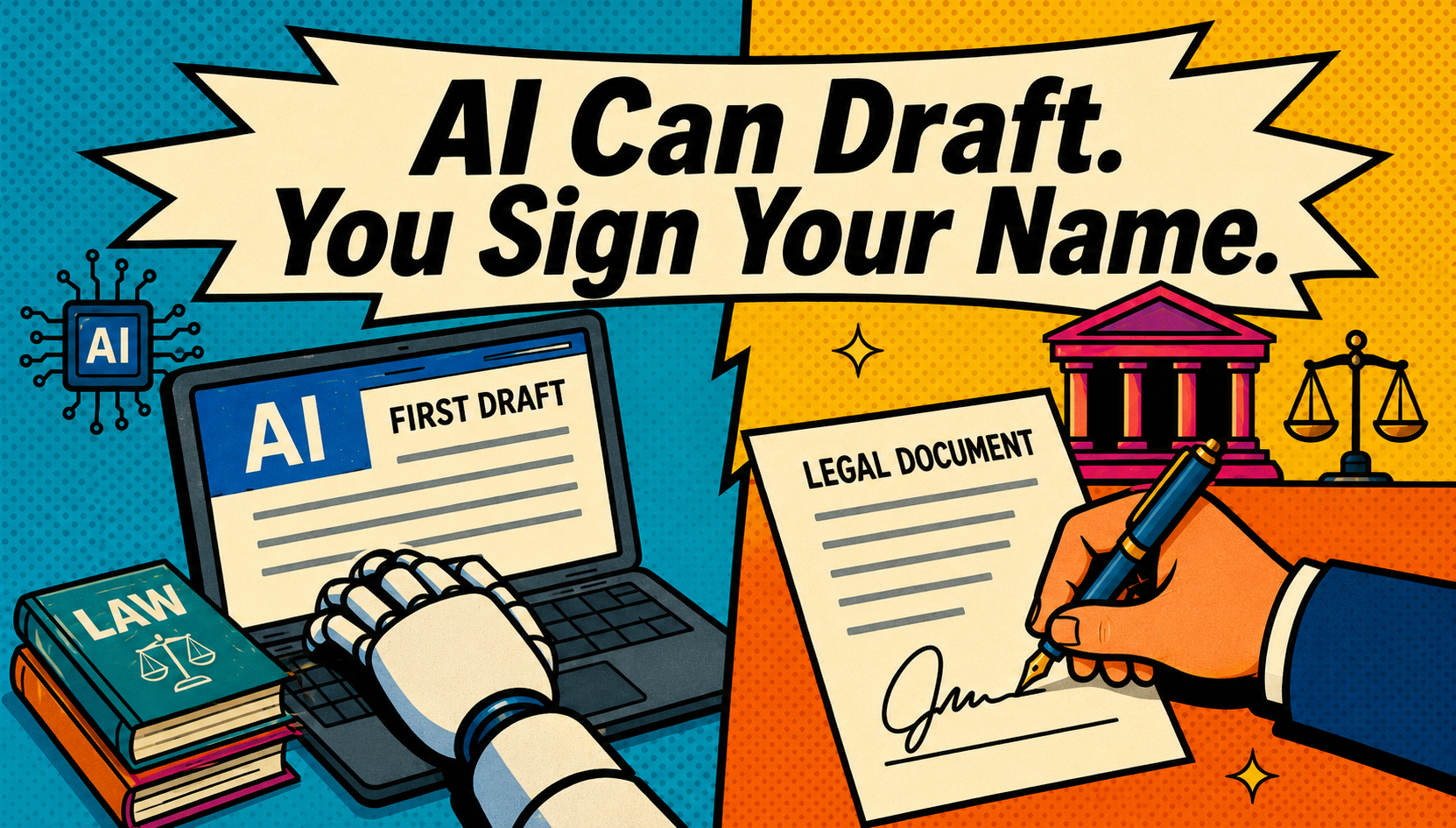
The legal profession is changing. Artificial intelligence is rapidly becoming part of legal practice. From summarizing cases and drafting correspondence to organizing research and generating first drafts of legal arguments, AI tools have the potential to make lawyers more efficient than ever before. Used thoughtfully, they can be valuable assistants.
But there is an important distinction that every aspiring legal professional, and every new lawyer, must understand. AI can assist your work. It cannot assume responsibility for it.
A recent disciplinary decision involving a senior Ontario lawyer serves as a reminder of that principle. The lawyer relied on AI-generated case citations that proved to be inaccurate and, more significantly, misled the court about how those authorities had been prepared. The result was professional discipline in the form of a six-month suspension, not simply because AI had been used, but because the lawyer failed to meet the standards of competence, honesty, and integrity expected of every member of the profession.
That distinction matters. The lesson is not that lawyers should never use AI. Nor is it that AI has no place in legal practice. Used responsibly, AI can improve efficiency, assist with drafting, summarize complex information, and help lawyers organize their thinking.
The lesson is that lawyers remain personally responsible for every authority they cite, every representation they make to a court, and every document they sign. AI may generate a first draft, but it cannot exercise professional judgment, verify legal authorities, or uphold a lawyer's ethical obligations. Ultimately, the lawyer, not the technology, is accountable.
For anyone preparing to enter the legal profession, this lesson is particularly important because the habits you develop today will shape the professional you become tomorrow.
For many, it is tempting to use AI as a shortcut. It can produce summaries in seconds, explain legal concepts, and generate answers that appear thoughtful and persuasive. Sometimes those answers are accurate. Sometimes they are not. The challenge is that AI often presents incorrect information with the same confidence and polish as correct information. Unfortunately, without the knowledge and judgment to recognize the difference, it becomes dangerously easy to mistake confidence for accuracy.
That is why legal education should never be viewed as an exercise in simply finding answers. Whether you are preparing for law school or studying for a licensing examination, your goal is not merely to arrive at the correct conclusion. It is to develop the habits and analytical skills that define an effective legal professional. It is also to develop the critical thinking skills that allow you to apply legal principles to new facts, first in examinations and eventually in practice.
During this stage of your legal education, you are building habits and skills that will stay with you throughout your career. The habit that matters most is not memorizing every case, it is learning how to analyze legal problems critically, verify authorities, and exercise independent judgment. Those are the skills that protect clients, earn the confidence of courts, and preserve the integrity of the legal profession. Those same habits also protect your professional reputation, one of the most valuable assets you will ever develop as a law student and lawyer.
That philosophy is reflected in how Emond Exam Prep's materials are designed. Our goal has never been simply to provide answers. Rather, we aim to teach learners how to identify legal issues, interpret legislation, understand the governing principles behind the law, distinguish between similar legal concepts, and apply legal reasoning in a structured and disciplined way. We encourage learners to understand why an answer is correct, not merely what the correct answer happens to be. We encourage learners to verify the cases, legislation, and legal principles they encounter, not because we expect our materials to be wrong, but because developing a habit of verification is one of the hallmarks of a competent legal professional. Those habits help prevent the kinds of mistakes that can lead to professional consequences.
Ironically, these are the very skills that enable legal professionals to use AI responsibly. Someone who understands legal principles can use AI to improve efficiency while recognizing when an answer is incomplete, unsupported, or simply wrong. Someone who lacks that foundation may not recognize an error until it has already found its way into a court filing, client opinion, legal submission, or other work product.
Technology will continue to evolve. AI tools will become faster, more sophisticated, and more capable. They will undoubtedly become a regular part of legal practice. What will not change is the professional's responsibility. Courts expect lawyers to verify their authorities. Clients expect legal professionals to exercise independent judgment. Law societies expect their licensees to act with honesty, competence, and integrity. None of those responsibilities can be delegated to a computer.
Whether you are in law school, studying for the licensing examinations, or beginning your legal career, remember that you are developing habits that will stay with you long after any exam is over. Every case you read, every authority you verify, and every legal problem you analyze is helping to shape the professional you will become. AI may change how legal work is performed, but it will never replace the judgment, integrity, and accountability that define an excellent legal professional.
AI can be an excellent assistant, but it can never be the lawyer. It is you who owes the duty to practice law and discharge your responsibilities to clients, the courts, and to the profession. That responsibility begins long before your first client. It starts while you are in law school and continues as you prepare for your licensing examinations and your legal career.