Christina Szurlej (St Thomas University), lead author and editor of our forthcoming publication Human Rights: Principles and Practice in Canada and Internationally (Emond, 2026), led a roundtable with three other contributors to the book: Kristi Heather Kenyon (University of Winnipeg), Saad Khan (University of Winnipeg), and Dominique Clement (University of Alberta).
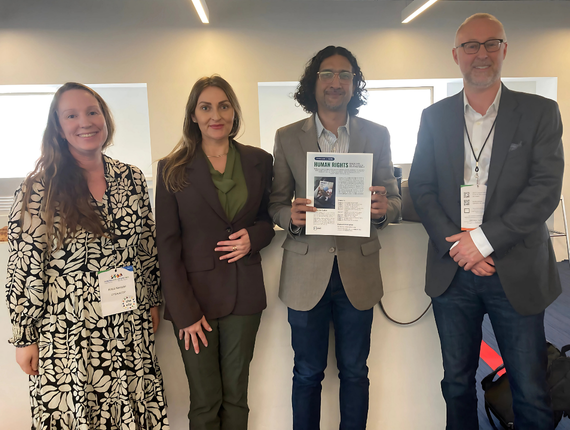
Kristi Kenyon, Christina Szurlej, Saad Khan, Dominique Clement
The authors discussed the book they’re working on, along with general strategies for teaching human rights to undergraduate students. Here are some highlights:
Kristi Kenyon:
Kristi spoke about how human rights are often taught in a way that is very state-centred. Challenging this approach, she aimed to include a wide variety of non-state actors to appeal to a wide range of students: she talks about everyone from participants in the Freedom Convoy to Manchester U fans to the movement to include environmental rights in the Charter. She spoke about choosing unexpected examples and examples rooted in place, highlighting, as a Manitoba-based scholar, groups like Meals on Wheels Winnipeg and Indigenous rights movements. Ultimately, Kristi pointed out, classroom time is limited, and you can’t unpack everything. How do you decide what needs unpacking? The book will help with this – setting out some clear and simple definitions of key concepts.
Saad Khan:
Saad talked about what he calls the St Augustine problem: everyone knows what time means until they have to explain it to someone (a Saad paraphrase)! He engages students by pointing to historical movements and their relevance in the present, referencing the Pakistan Bar Council and how that became a bigger political movement. Then, could the States learn from this example? One phrase he said caught my eye: “The more repressive the state, the more extreme the resistance will become.”
Dominique Clement:
Dominique often starts by challenging his students to think of a language to use for social change other than human rights. He uses this as a way of showing students how human rights language has emerged as a global vernacular since the 1970s. He challenges students to consider that if everything is a right then nothing is a right. Human rights should be the highest moral claim in any society, so we should be wary of framing just anything in this language. It’s the narrow definition of it that enabled human rights to be a popular rallying cry across different groups.
Christina Szurlej:
Christina teaches with a message of hope. Human rights education and research are increasingly under global threat—both ideologically and institutionally. Canada plays a critical role as a site of resistance, innovation, and scholarship, even as its infrastructure remains uneven. Christina takes a holistic approach to educating her students. She called on instructors to address mental health and sustainability, given the emotional demands of justice work; to teach global competencies: language skills, cultural fluency, political awareness; to provide concrete pathways: internships, clinics, placements—bridging classroom and community; and to strengthen institutional supports, including mentorship, peer networks, and career planning.
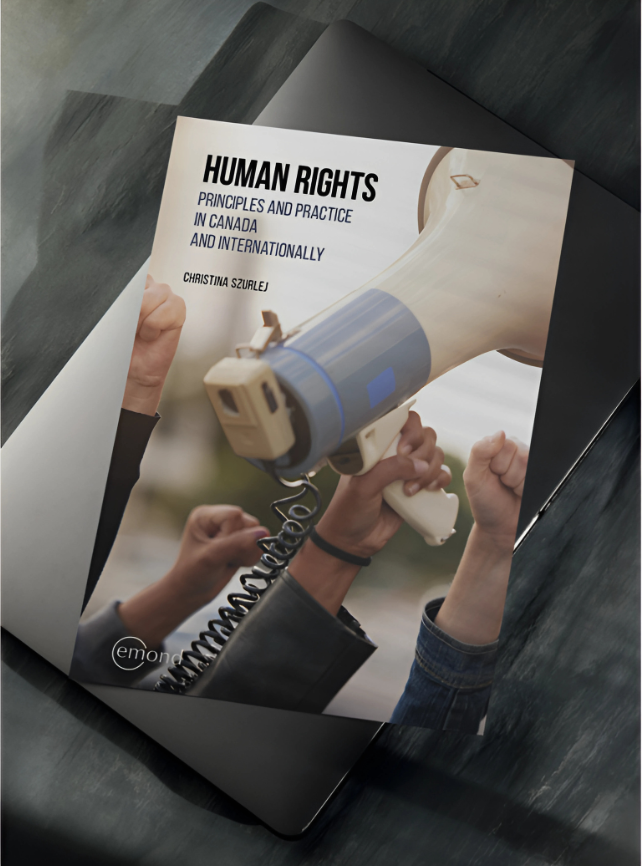 Human Rights: Principles and Practice in Canada and Internationally is available for purchase now.
Order Your Copy Today!
Show Me More!