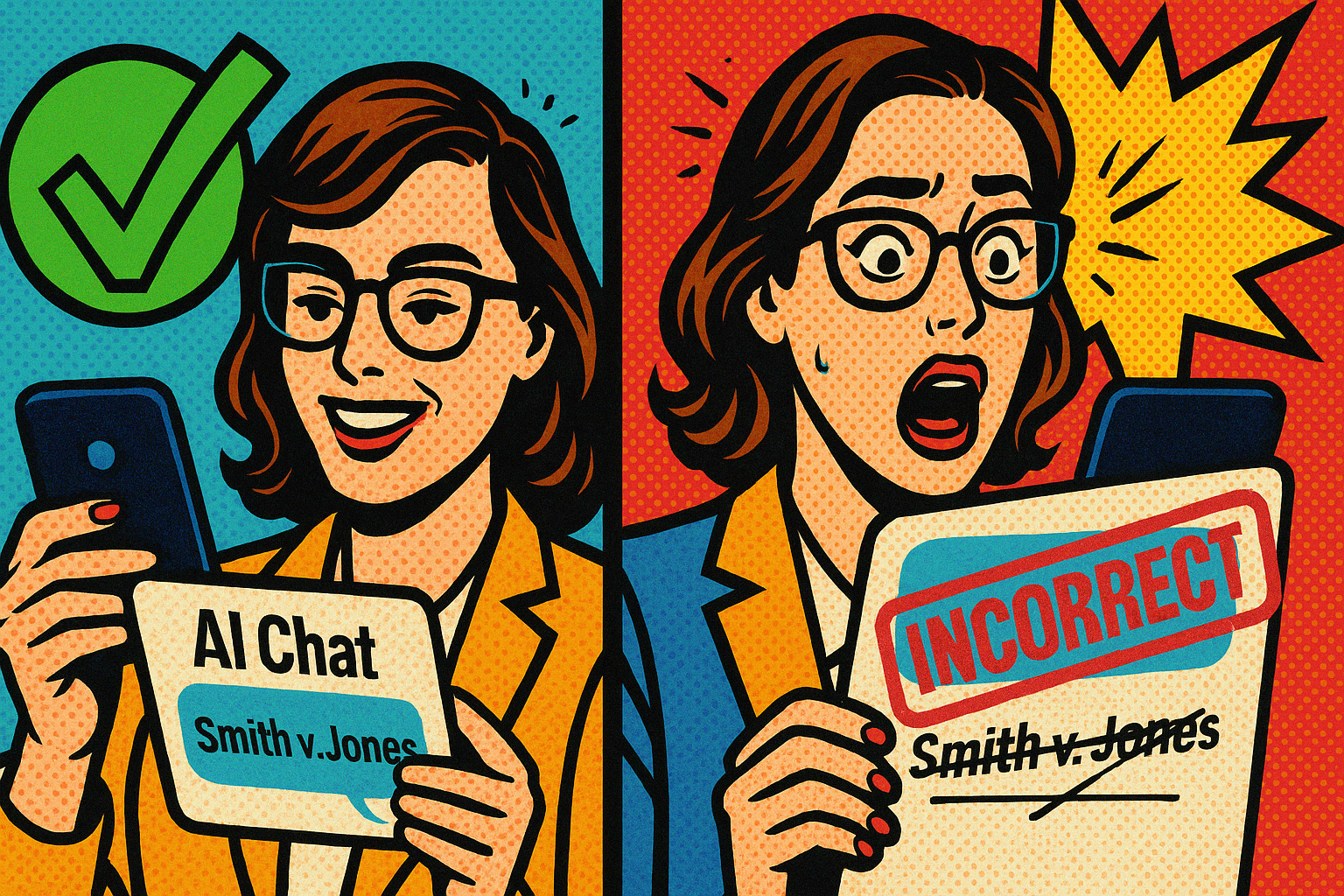
Each month, we explore a common misconception about AI, its role in legal education, and what licensing candidates should keep in mind when using these tools to prepare for their exams.
When you’re preparing for a licensing exam, time is your most valuable resource. It’s tempting to turn to AI tools like ChatGPT for quick explanations or answers to difficult practice questions. After all, these systems seem confident, polished, and fast — exactly what a busy candidate needs. But that confidence can be misleading. The truth is, AI doesn’t always give the right answer, and sometimes, it’s not even close.
Why This Misconception Feels True
It’s easy to understand why so many exam-takers believe AI can provide reliable, accurate information.
First, AI sounds authoritative. It presents answers in a tone that feels professional, complete, and well-reasoned. It rarely hesitates or signals uncertainty, which can create a false sense of trust.
Second, AI’s speed and convenience make it appealing. When you’re trying to review hundreds of pages of material, or you just want to confirm your understanding of a concept, AI’s ability to deliver an instant answer feels like a huge advantage.
Finally, the marketing narrative around AI reinforces the illusion of accuracy. We hear phrases like “intelligent,” “smart,” and “trained on vast data sets,” which can give the impression that AI knows everything worth knowing. But in law, and especially in licensing preparation, “knowing” is not the same as “predicting,” and that distinction matters.
Where the Reality Breaks Down
The biggest misconception about AI is that it knows things. Tools like ChatGPT don’t “understand” content the way humans do. They are pattern recognition systems, predicting the most likely next word in a sentence based on training data. That means AI doesn’t verify facts or reason through arguments. AI simply generates text that sounds right.
And while that text can be useful, it’s also prone to serious errors.
1. AI Hallucinations
AI “hallucinations” occur when an AI tool invents information that doesn’t exist. These can include fake case names, incorrect legal principles, or citations that look real but are completely fabricated. These errors can be difficult to spot unless you already know the correct answer, which is a dangerous trap for licensing candidates.
For example, in 2024 a British Columbia lawyer was ordered to pay costs after submitting a court filing that included fictional case citations generated by AI[1]. In another example, the Quebec Superior Court reprimanded a lay litigant and ordered him to pay $5,000 for doing the same[2]. Similar incidents have occurred in other jurisdictions, including the United States, underscoring the risks of relying on AI without verification.
2. Lack of Context
Even when AI provides factually correct information, it often misses the context. Law is nuanced and highly dependent on jurisdiction, procedure, and application. An AI-generated answer may generalize or oversimplify key details, leading to incorrect reasoning or incomplete analysis. These are mistakes that can be fatal in a licensing exam setting.
3. Inconsistent Quality
The quality of AI responses varies depending on how the prompt is worded and what the system “interprets” as relevant. You might receive a clear and accurate answer one time and a misleading one the next without realizing it. That inconsistency makes AI unreliable as a primary learning source. Even when using AI to generate practice questions, AI was found to create questions and explanations based on repealed legislation and incorrect interpretation of law.
Why This Matters for Licensing Candidates
Licensing exams, whether for paralegals, lawyers, or internationally trained candidates, don’t just test whether you can recall information. They test whether you can analyze, apply, and justify your reasoning. AI tools are not equipped for that level of critical interpretation.
If you rely on AI answers without verification, you risk building your study approach on unstable foundations. You might walk into the exam confident in a principle or rule that AI explained incorrectly, or you answered correctly in a generated question, but by the time you realize the AI was incorrect, it’s too late to fix.
In essence, AI can accelerate your studying, but it can’t replace your reasoning and diligence. Its purpose is to supplement your understanding, not substitute for it. The key is to stay in the driver’s seat. AI can support your study efforts, but it can’t replace the critical thinking, analytical precision, and attention to nuance that professional licensing requires. It also cannot replace the meticulous and careful design of human-made prep materials, particularly practice exams.
Final Takeaway
AI is a remarkable tool, but it’s not a legal expert, and it certainly isn’t infallible. When you’re studying for licensing exams, your understanding must be grounded in verified knowledge and human reasoning. Treat AI’s output as a starting point, not a final authority. AI gets things wrong.
Accuracy in law comes not from how fast you find an answer, but from how deeply you understand why it’s right. That’s something no algorithm can do for you. Successful performance on the licensing exam also requires working with prep products that are reliable and reflective of what you will experience.
🧠 Study Tip:
If you’re using AI to review or clarify legal topics, always run a “fact check” step afterward. Take one point from the AI’s response and confirm it against your study materials. You’ll build both your confidence and your ability to spot when something doesn’t sound quite right, an essential skill for both exam success and real-world practice.
[1] https://www.canadianlawyermag.com/resources/professional-regulation/bc-lawyer-ordered-to-pay-up-for-attempting-to-use-chatgpt-hallucinations-in-application/384023
[2] https://jusmundi.com/fr/document/decision/fr-united-mining-supply-and-specter-aviation-ltd-v-jean-laprade-ultragold-guinee-and-world-aircraft-leasing-inc-jugement-de-la-cour-superieure-du-quebec-2025-qccs-3521-wednesday-1st-october-2025